
Environmental Initiatives
- Home
- ESG Initiatives
- Environmental Impact Reduction Initiatives
- Initiatives for climate change
(TCFD etc.) - Environmental Impact Reduction Initiatives
- Environmental performance
Introduction of LED Lighting
Continued to introduce LED lighting to reduce electricity bills and CO₂.

<Case example>
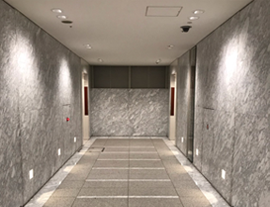
Yokohama
ELV hall
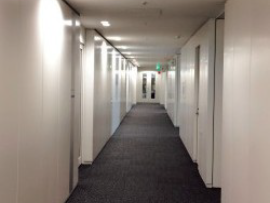
Saitama
Common hallway on standard floors
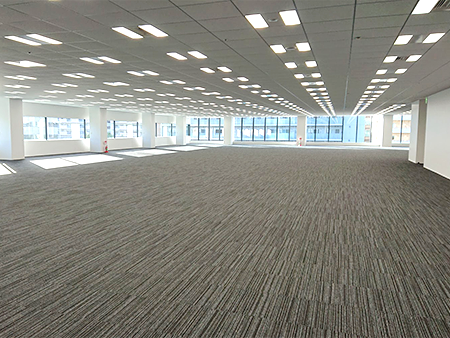
Toyosu Dedicated areas
Other Achievements
- Elevator Hall [Midosuji]
- Entrance [Saitama]
- Underground parking lot [Saitama]
Greening of Rooftop [Toyosu Prime Square, Yokohama Plaza Building, etc.]
Worked on greening rooftop facilities of owned properties.
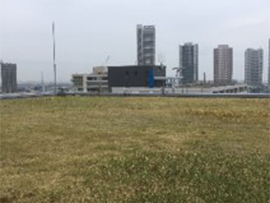
Toyosu Prime Square
(Rooftop)
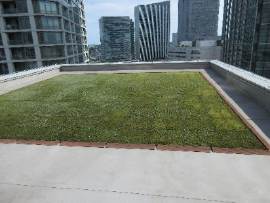
Yokohama Plaza Building
(Rooftop)
Case Example of Using Renewable Energy [ARK Hills Sengokuyama Mori Tower, Hirakawacho Mori Tower]
Solor panels were installed on the rooftop to utilize renewable energy.
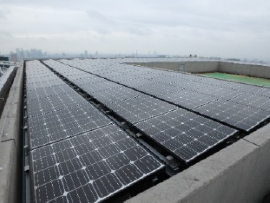
ARK Hills Sengokuyama Mori Tower
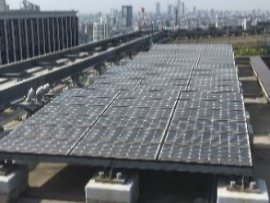
Hirakawacho Mori Tower
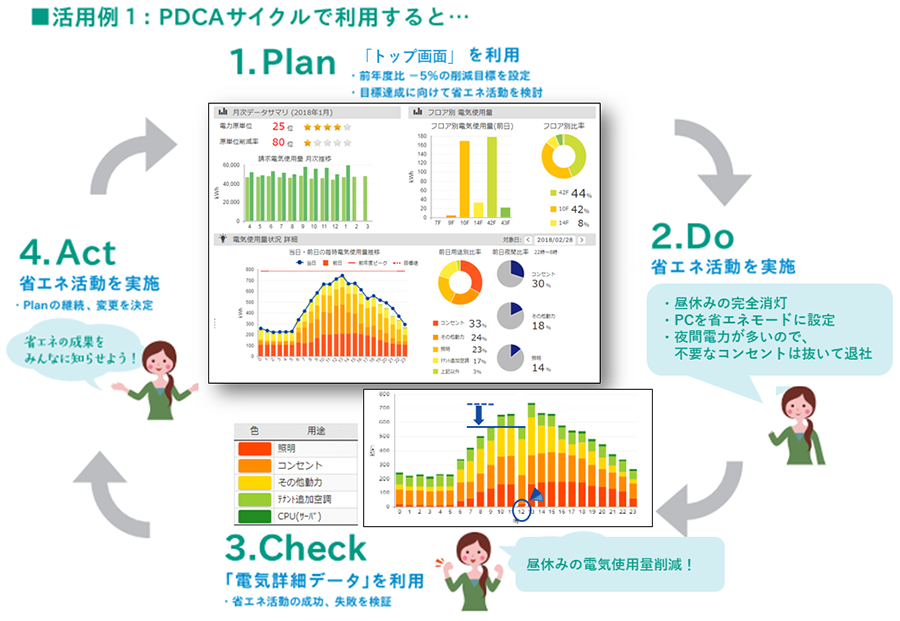
Introduction of Energy Web System
[ARK Hills Sengokuyama Mori Tower, Meiji Yasuda Life Insurance Saitama-Shintoshin Building, etc.]
Energy consumption in the dedicated areas are visualized to support active energy saving measures by tenants.
Creation of Green Areas to Promote Biodiversity [ARK Hills Sengokuyama Mori Tower]
Reference: Granted an AAA, the highest JHEP accreditation
![Creation of green areas to promote biodiversity [ARK Hills Sengokuyama Mori Tower]](/assets/img/esg/environment__sengokuyama-moritower--en.png)
Shin‐Daibiru Building
The Shin-Daibiru Building Dojima-no-mori Garden (lit. “Dojima Forest”) carries on the spirit of the rooftop tree garden of the former Shin-Daibiru Building. In addition to transplanting some of the 50-year-old trees from the old rooftop tree garden, hich included Japanese maples and elms, we created a 3,300 m² green space, roughly the same size as the previous garden, using mainly native species. Biodiversity monitoring surveys conducted by external agencies in fiscal 2016, 2020, and 2024, after the completion of the Shin-Daibiru Building Dojima-no-mori Garden, confirmed that a stable food chain had been established within the forest. A habitat in the urban area like this is precious for birds and insects, and its contribution to the ecosystem was highly evaluated.
For details, please refer to the Daibiru’s website
Ecosystem pyramid
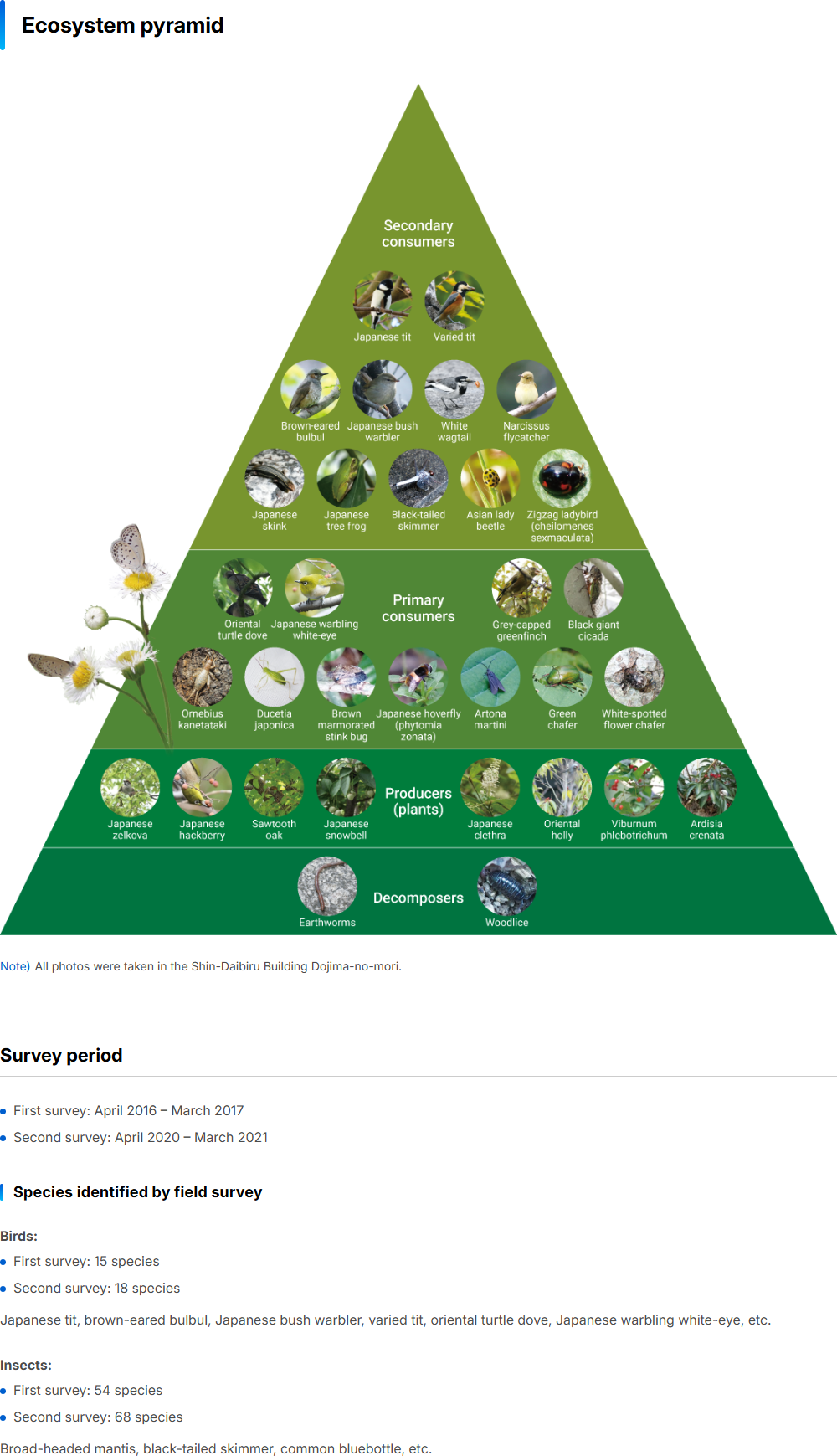
- All photos were taken in the Shin-Daibiru Building Dojima-no-mori.
Survey period
- First survey: April 2016 – March 2017
- Second survey: April 2020 – March 2021
- Third survey: April 2024 – March 2025
Species identified by field survey
Birds:
- First survey: 15 species
- Second survey: 18 species
- Third survey: 12 species
Japanese tit, brown-eared bulbul, Japanese bush warbler, varied tit, oriental turtle dove, Japanese warbling white-eye, etc.
Insects:
- First survey: 54 species
- Second survey: 68 species
- Third survey: 64 species
Broad-headed mantis, black-tailed skimmer, common bluebottle, etc.
Promotion of Conclusion of Green Lease Agreements
"Green lease" refers to the voluntary agreement on the cooperative promotion of environmentally friendly initiatives such as the reduction of energy consumption and waste and the acquisition of environmental certifications by building
owners and tenants reached by concluding lease contracts, etc., and the implementation of such initiatives.
GOR promotes the incorporation of green lease clauses into lease contracts as an endeavor on conservation of energy and CO₂ emissions reduction in cooperation with tenants.
-
The KPI for the conclusion of green lease agreements was changed from “Implementation rate in new contracts” to “Implementation rate in all contracts” in fiscal 2022.
In fiscal 2025, the implementation rate in new contracts was 100% (excluding master lease agreements) and the implementation rate in all contracts was 55.8%.
Cooperation with Business Partners
■Sustainable Procurement Policy
GAR has established the "Sustainable Procurement Policy" as one of the policies for putting into practice the individual items of the "Basic ESG Policy." Under this policy, GAR promotes initiatives taking into consideration sustainability in the supply chain by setting guidelines related to the selection of products giving attention to the environment and health as well as the selection and evaluation of contractors, etc.
■Evaluation Criteria of PM Companies
GAR has set a selection criteria, etc. for property management companies to which it entrusts management of properties and also evaluates all property management companies once a year in principle. Upon such assessment, GAR takes into consideration points such as the status of environmental consideration in business, occupational safety and health of employees, and understanding and cooperation regarding the Basic ESG policies set by GAR, in addition to items related to building management capacity and repair work capacity.
■Initiatives on the Improvement of Tenant Satisfaction
GOR regularly conducts tenant satisfaction surveys, and by sharing the results of the survey with property management companies and building management companies, strives to create an environment where all tenants can spend a comfortable time and improve building services.